Эрдсийг эрдэнэст
Ирээдүйг өндөр хөгжилд
Ирээдүйг өндөр хөгжилд
Mining The Resources
Minding the future
Minding the future
By B. Tugsbilegt
Mongolia is widely recognized as a major supplier of raw materials to the global market, particularly coking coal, copper, and cashmere. In fact, it can be said that these three sectors have firmly inscribed the name "Mongolia" onto the global value chain. Among them, coal deserves special attention. We are living in a time when we have reason to be grateful for our coal resources.
While it is true that coal's reputation has suffered in recent years, as it does not fall under the category of "green" energy, it remains undeniable that coal has been a key driver of Mongolia's economic growth. In 2010, the country celebrated when coal exports reached 16 million tons. In the following years, exports steadily rose toward 30 million tons, eventually approaching nearly 40 million tons - a level that, at the time, seemed likely to be maintained.
However, this expectation has now been completely overturned. Ambitious targets - discussions of coal exports reaching or potentially exceeding 100 million tons - are now being considered in concrete terms. Until recently, Mongolia's name barely appeared on the global map of coking coal exports. The very fact that exporting 100 million tons of coal has become a national objective signals that Mongolia is undeniably attracting global attention. In other words, the country has emerged as a significant player on the world stage.
Moreover, this expansion of Mongolia's coal sector may only be the beginning. In the coming years, not only is coal production expected to grow substantially, but large-scale coal-fired power plants and major industrial complexes are also anticipated to come online. It remains far too early to predict just how significant the economic returns from coal will ultimately be for Mongolia.
Mongolia's rapid and dramatic surge in coal exports has drawn widespread attention both at home and abroad. Yet it is no secret that, at present, this growth does not appear particularly "green," and this is a factor we must acknowledge.
Major coal-exporting countries such as Australia and Indonesia seem well-prepared with their messaging at international green forums and conferences, equipped with established strategies and playbooks. While Mongolia is not yet a player on their scale, as a newly emerging coal exporter, it would be prudent to learn early from their experience.
With its rapid rise in 'coal status,’ Mongolia needs to develop the ability to clearly explain, defend, and advocate for its position under international green policy frameworks. The days are approaching when Mongolia must be able to offer clear answers to specific questions on the global stage.
In other words, managing the growth of the coal sector in parallel with green policy considerations is delicate and complex. While the expansion of the coal industry underpins Mongolia's long-term economic outlook, green issues cannot be ignored. Maintaining a balance between these two critical priorities represents the correct development path for Mongolia.
When it comes to coal, Mongolia primarily exports coking coal used in steelmaking, while domestically it relies on thermal coal to fuel its power plants. As of the end of 2025, Mongolia's total installed power generation capacity stood at 1,808 MW. According to the Ministry of Energy, thermal power plants accounted for 1,464 MW (81%), wind power for 155 MW (8.6%), solar power for 155.5 MW (8.6%), and hydropower for 26.04 MW (1.4%).
Under the government's five-year development guidelines for 2026-2030, Mongolia aims to expand its total power generation capacity to 4,168 MW. On the surface, green alternatives such as solar, wind, and hydropower appear more attractive and environmentally friendly. However, coal remains the most reliable source of energy.
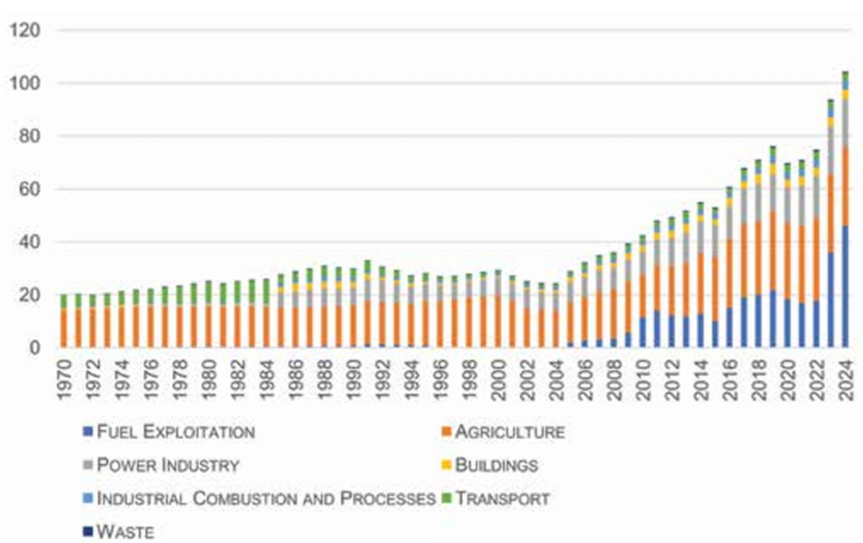
Mongolia's greenhouse gas emissions, by sector, million tons, 1970-2024
During periods of peak demand, coal provides Mongolia with stable and reliable power precisely when it is needed most. Renewable energy, by contrast, behaves quite differently under such conditions.
At peak load times, the supply from renewables can effectively vanish. While renewable projects are often described as having capacities of 50 MW, there are occasions when their actual output during peak demand drops to half that - or even lower.
This is not the case with coal-fired power plants. They deliver precisely what they promise, consistently and without shortfall. This is not an attempt to defend coal; it is simply the reality. At present, coal-fired power plants have proven to be a genuinely reliable, stable, and affordable source of both electricity and heat for Mongolia.
Although coal's reputation has declined in recent years under the influence of international green policies, it has nonetheless maintained its status as a reliable and stable energy source. For this reason, Mongolia faces the necessity of continuing to develop a substantial number of coal-fired power plants. Over the next five years, the country plans to nearly double its current coal power generation capacity.
As development progresses, energy demand is set to increase rapidly. Mongolia will need to provide electricity for major projects such as Oyu Tolgoi, large-scale coal developments, and other significant industrial complexes. At the same time, green energy will continue to be pursued alongside conventional sources. The key is not place too great or exclusive expectations on green energy.
With regard to renewable energy, the Ministry of Energy announced at last year's AmCham conference that Mongolia is scheduled to hold its first-ever tender for wind and solar power plants in May 2026, with both domestic private companies and foreign investors able to compete.
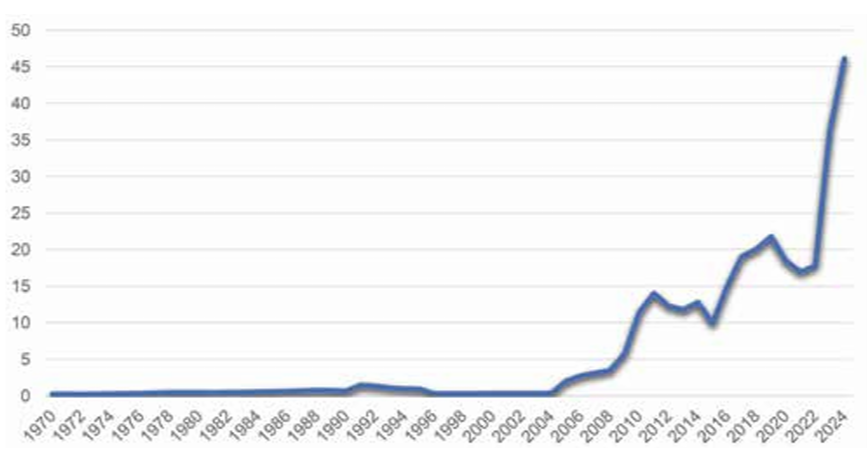
Growth in greenhouse gas emissions from fuel Exploitation in Mongolia, million tons, 1970-2024
However, the International Finance Corporation (IFC) has cautioned that electricity prices from renewable energy may not decrease as much as expected through the tendering process. Currently, wind power plants sell electricity to the central grid at 9.5 US cents per kilowatt-hour. How much this price will drop as a result of the upcoming tender will therefore be closely watched.
Newly commissioned coal-fired power plants in Mongolia, such as Buuruljuut, have signed agreements to sell electricity at 8.5 US cents per kilowatt-hour. While this price may seem relatively high, it is justified by the stable and reliable supply of electricity, the need for which has become increasingly evident in recent times.
The competition between renewable energy and coal-fired plants became particularly evident during recent electricity shortages. Renewable energy is often said to be able to provide more stable power with the support of battery storage. However, the investment costs and efficiency of battery storage require careful consideration.
At present, the cost of battery storage remains high, with minimum expenses estimated at around $100,000 per megawatt. This adds a significant financial dimension to the challenge of stabilizing renewable electricity supply.
Mongolia's coal sector holds significant potential for advanced processing, including coal liquefaction and the production of synthetic fuels, and even the development of hydrogen. This indicates that policies and measures for the coal industry need to be developed with a very high level of precision and sophistication. These points relate primarily to thermal coal used for energy. However, the majority of Mongolia's export coal is coking coal. Unlike regular thermal coal, coking coal plays a crucial role in steelmaking. It can be considered a "rare mineral" in this sense. Recently, the Trump administration added coking coal to the list of minerals critical to the US economy and national security.
This designation is not particularly surprising. It simply underscores how vital coking coal is as a raw material. The world is living in the era of steel, and although we often speak of entering the Fourth Industrial Revolution and the age of information technology, it is impossible to imagine national development without steel products. Similarly, steel production today cannot be envisioned without coking coal.
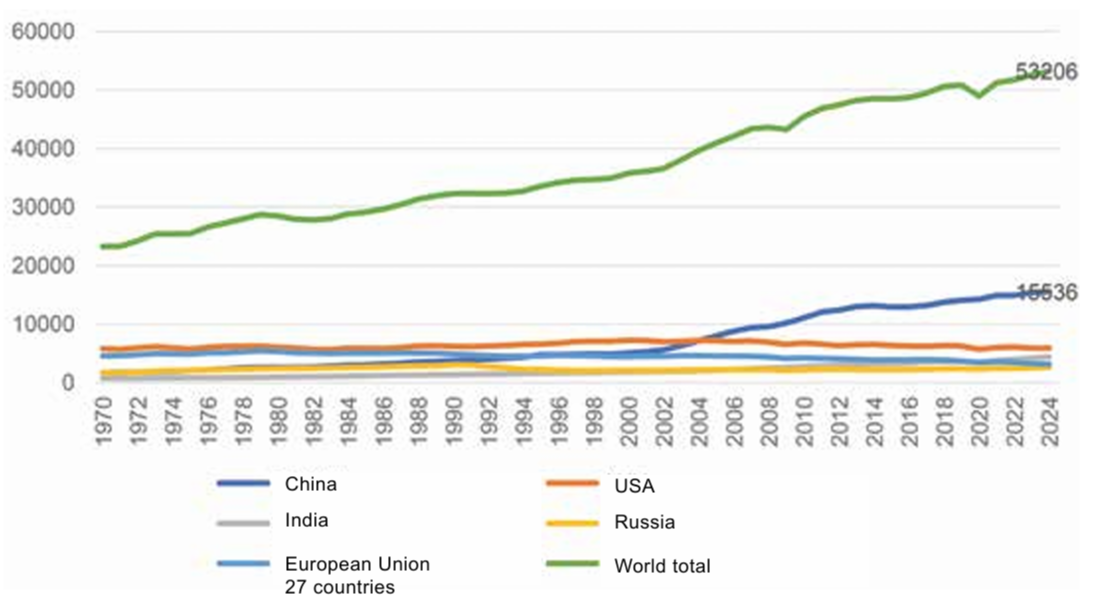
Global greenhouse gas emissions and some major countries' indicators 1970-2024 (million tons)
On the other hand, the international community continues to observe the increase in greenhouse gas emissions resulting from coal expansion. It is important to remember that foreign green organizations are actively monitoring and measuring these developments.
At present, Mongolia contributes only a very small share to global greenhouse gas emissions overall. However, when measured on a per capita basis, the country ranks unusually high. According to the 2025 Global Greenhouse Gas Emissions Report by EDGAR, the research arm of the European Commission, Mongolia is ranked sixth in per capita emissions, behind oil-exporting nations such as Qatar and Kuwait. Even major emitters like China, the United States, and Australia fall behind Mongolia on a per-person basis.
The primary reason for Mongolia's high per capita ranking is its small population, which amplifies per-person figures. At the same time, as mineral extraction - particularly coal mining - expands, total emissions naturally rise. The sector driving Mongolia's greenhouse gas emissions is classified as fuel exploitation. While the report does not explicitly mention coal, the category "fuel exploitation" includes emissions from the mining, transportation, and processing of fuels.
In Mongolia, emissions from fuel exploitation rose sharply, reaching 46 million tons in 2024 - a nearly 300% increase compared to 2010. Following the extraction sector, agriculture and energy production also contribute significant shares to the country's greenhouse gas emissions.
In terms of total greenhouse gas emissions, Mongolia reached 104 million tons in 2024, accounting for less than 0.2 percent of the global total (53.2 billion tons). Mongolia is ranked 53rd highest out of more than 200 countries.
Most countries around the world have pledged to achieve net-zero emissions by 2050 to limit average global warming to 1.5°C. However, despite these commitments, total global greenhouse gas emissions continue to rise steadily.
The global momentum of green policy has arguably weakened since the United States, the world's largest economy, withdrew from the Paris Agreement. Meanwhile, although greenhouse gas emissions in the European Union are declining, many of its major industrial facilities are being relocated to other countries.
This creates a pattern in which emissions in Western countries are decreasing while China's emissions are increasing rapidly. However, shifting the location of the components does not change the overall total. In essence, this trend does not represent a genuinely effective green policy. As a result, there has been social criticism that Europe's industrial sector is facing decline, with rising unemployment as a consequence.
Last year marked a historic moment, as major countries - particularly India and China - simultaneously saw declines in coal-based power generation, according to Carbon Brief. In both nations, the reach of solar, wind, and hydropower has been expanding rapidly.
However, new coal-fired power plants with the latest environmentally friendly designs continue to come online one after another. For example, China commissioned coal plants totaling 80 GW of capacity in just a single year. In India, while the scale is smaller, new coal plants are also being constructed in succession.
This demonstrates that coal remains a resilient and enduring presence on the global energy stage.
Major coal-producing countries such as Australia, Indonesia, and South Africa proudly announce bold plans to close their coal plants at international green forums. However, as the deadlines for these closures approach, they continue to extend their timelines.
Amid rising natural gas prices, European countries have even restarted some of their old coal plants. Meanwhile, countries that still rely on traditional coal-based energy often view the pressure to abandon it under the label of "renewable and green" as unfair. Furthermore, the promised green investments from major countries to support coal plant closures have largely stalled, further slowing progress.
Countries are avoiding abrupt green policy transitions and instead prefer to pursue a 'dual track' approach. Mongolia also seems likely to fall into this category.
In any case, Mongolia's coal sector is expanding. This makes it increasingly necessary to define coal policy at a higher level, coordinating it across all major sectors.