Эрдсийг эрдэнэст
Ирээдүйг өндөр хөгжилд
Ирээдүйг өндөр хөгжилд
Mining The Resources
Minding the future
Minding the future
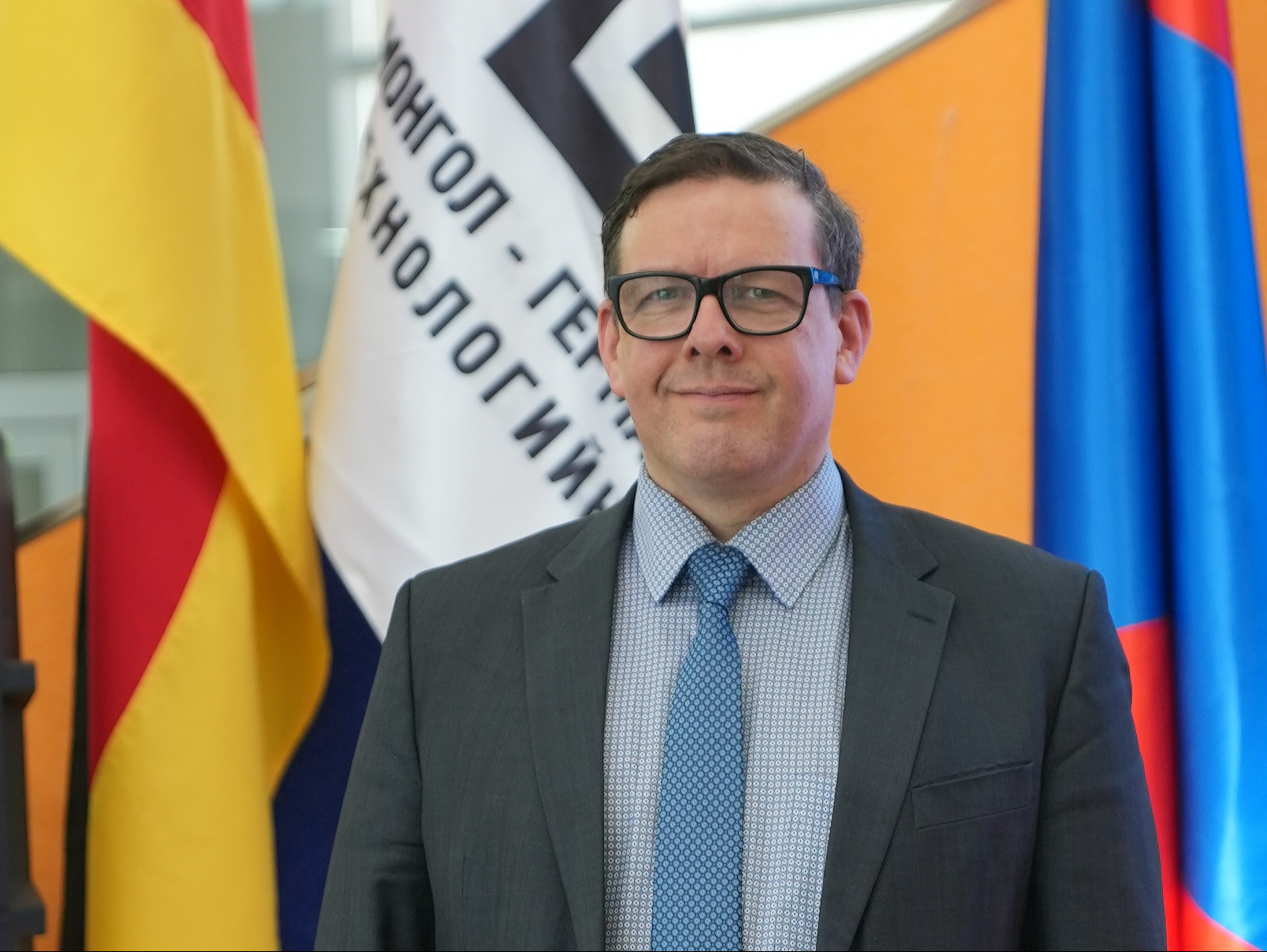
In this interview, Sebastian Burghof, Programme Manager at Deutsche Gesellschaft für Internationale Zusammenarbeit (GIZ), discusses how the new advanced mineral research laboratory at German-Mongolian Institute for Resources and Technology (GMIT) reflects German engineering standards and strengthens Mongolia’s mining research capacity.
GMIT is known for bringing German engineering excellence to Mongolia. In your opinion, how does this new advanced mineral research laboratory align with the technical standards found in German universities, and what does this mean for the quality of research here?
My name is Sebastian Burghof, and I work for GIZ here in Mongolia on behalf of the German Ministry for Economic Cooperation and Development. We are currently implementing the German-Mongolian Institute for Resources and Technology (GMIT) project.
This laboratory is a highly sophisticated facility. The Mineral Liberation Analyzer (MLA) is an advanced analytical instrument used specifically for raw material processing. Because this equipment is so complex, the engineers and researchers operating it require an advanced level of technical knowledge. In this regard, the laboratory aligns perfectly with the standards of German engineering education.
A significant point to highlight is that this laboratory enables GMIT to cooperate directly with the private sector. The university is now capable of performing high-quality, industrial-grade research for mining companies. This marks a major transition for GMIT from being primarily a teaching university to becoming a research university.
By providing these services, the university helps the Mongolian mining sector operate more effectively and reduces the turnaround time for critical data. For the university itself, this creates a path to generate its own income, which is vital for its long-term sustainability.
From my perspective, the greatest value lies with the students. Access to such high-tech equipment ensures they receive a superior education. When these students graduate, they will be significantly more valuable to Mongolian mining companies because they have already mastered world-class technology.
GIZ has been a long-standing partner of GMIT. How do you see this new facility contributing to the transfer of German "know-how" to the Mongolian mining sector, and will it help bridge the gap between academic research and industrial needs?
The gap between academic research and industrial needs is a critical issue. This is exactly what modern universities must address. In Germany, universities have decades of experience working with this specific type of equipment.
Our role at the GIZ-GMIT project is to facilitate the transfer of that experience. We don't just provide the hardware, we invest in the people. For instance, we sent GMIT academic staff to Germany to train with experts who have used these systems for years. They didn't just learn basic operations, they learned the maintenance, the sustainable management of the lab, and those "hidden tricks" of the trade that you only acquire after years of hands-on experience. Two of our researchers have just returned to Mongolia equipped with that specialized knowledge.
In Germany, the intersection between applied research, research specifically designed to solve company problems and university education is very strong. By learning directly from German partner universities that already operate this way, GMIT is positioning itself at the cutting edge. This facility is the physical space where that German model of industry-academia collaboration will take root in Mongolia.
With the introduction of this new technology, how much of a competitive edge will students have when working for international companies?
It is difficult to put an exact figure on it, but what I can say with certainty is that GMIT students are already highly sought after by internationally-oriented companies in Mongolia.
With the addition of this equipment, their value increases significantlty, not just for individual companies, but for the entire Mongolian mining sector. These students aren't just learning theory; they are mastering a world-class tool that is used at the highest levels of global industry. If I had to quantify the impact, I would say this experience makes a graduate at least 50% more valuable to a prospective employer. They are entering the workforce with a specialized technical edge that is very hard to find elsewhere.
Is there anything else you would like to add?
GIZ is a very specialized institution in Mongolia, and I believe that relative to its size, GMIT has the strongest international connections of any university in the country. This year alone, we have already hosted three visiting professors from Germany for teaching and research.
Beyond what our project provides, GMIT takes a lot of initiative on its own. I truly believe that for anyone considering their options, studying at GMIT is the closest experience you can get to studying abroad while staying in Mongolia. It is a unique bridge between the two countries.
Thank you for your time.